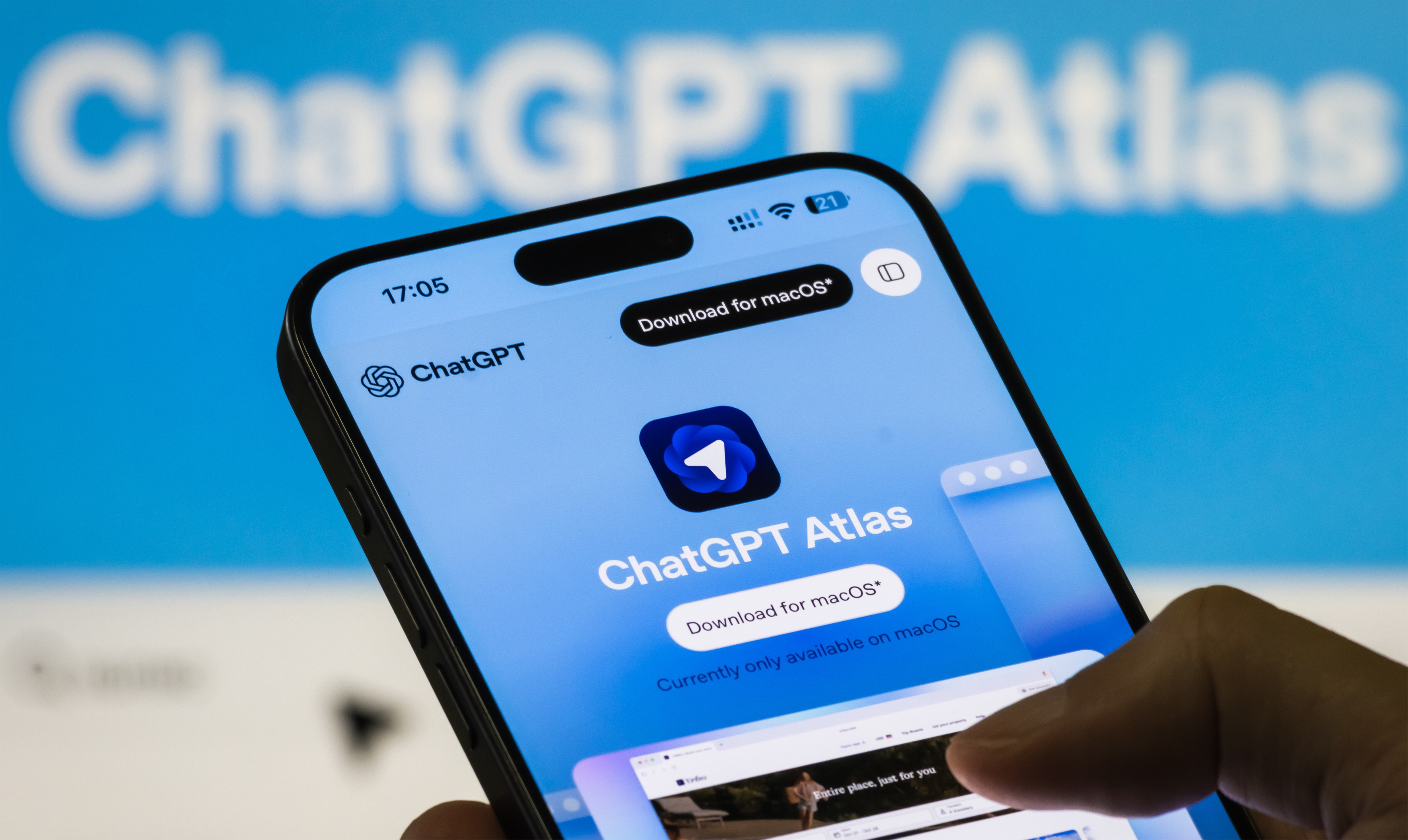
For the last two years, our focus has been on optimising content for the LLM answer layer over traditional search results. That fundamental optimisation goal has just been disrupted. This strategic shift demands a new, foundational approach for marketers: Agent Experience Optimisation (AXO). With the launch of ChatGPT Atlas, a full web browser with built-in intelligence, the AI assistant is no longer in the interface; the assistant is becoming the interface.
Simultaneously, the competitive landscape is escalating:
- Google is embedding Gemini directly into Chrome with AI Mode, designed to handle complex, cross-session queries and hinting at agentic capabilities to “do tasks for you.”
- Microsoft shipped Copilot Mode in Edge, with the ability to analyse tabs and soon history and credentials, empowering the agent to assist with real-world actions.
- Atlassian recently acquired The Browser Company to develop a work-first AI browser.
- Opera debuted Neon, an “agentic” browser focused on direct task execution.
- Perplexity’s Comet has moved past its waitlist to become a widely available, AI-first browser built for research, synthesis, and action.
This synchronised push by all major tech players forces a critical question: is the browser the next critical AI frontier, or merely a temporary trend?
What Atlas Actually Is (and Its Game-Changing Features)
Atlas is built on Chromium but features deep integration with ChatGPT at every point of the user workflow. Key launch features include:
- Ask ChatGPT Anywhere: A persistent sidebar that has full context of the page you are viewing. Users can “chat with” the content, asking the model to summarise, compare, draft, or extract data directly without manual copy-pasting.
- Memory That Travels: Your existing ChatGPT memory now functions inside the browser. This includes new, optional browser memories that remember context from sites you visit, all fully manageable and clearable in settings. (Anticipate discussions on tracking and data security to follow.)
- Agent Mode: This is the most significant feature for brands (currently for paid users). It grants ChatGPT permission to open apps and click through entire workflows to accomplish tasks, such as “compare pricing for hotels,” “add five products to my cart,” or “complete the checkout process.”
- Agent SEO (The First Clue): OpenAI specifically highlighted the use of ARIA tags, the accessibility labels used by screen readers—as crucial for helping the agent reliably interpret page structure and interact with elements. This is the first practical hint at “Agent SEO”: sites with superior ARIA markup will perform better with ChatGPT.
OpenAI positions Atlas as a foundational step toward a “super-assistant” and a major platform play. The ability for third-party apps to live inside ChatGPT, combined with an SDK, means the assistant is becoming an OS-like surface where discovery and action converge.
Functionally, This is an OS Play
OpenAI is openly shifting ChatGPT from a simple chatbot to a platform full of third-party applications. These apps are contextual, interactive, and now live within a first-party browser, effectively locking in the operating environment where users ask, decide, and ultimately buy.
The introduction of Instant Checkout, allowing users to purchase products directly within the ChatGPT interface while merchants handle fulfilment, makes the commerce angle crystal clear. If the assistant serves as both the point of discovery and the checkout counter, then brand discovery and conversion collapse into a single, conversational funnel.
The Rest of the Browser Market is Racing
OpenAI’s move puts immense pressure on every other industry player.
- Google Chrome is incorporating Gemini for cross-tab analysis, page summaries, and new agentic shopping features tied to its vast Shopping Graph data. Chrome is evolving into a core distribution channel for Gemini.
- Microsoft Edge’s Copilot Mode unifies search and navigation in an interface very similar to Atlas. Future updates will enable the model to execute tasks like booking and buying by accessing history and credentials (with user permission).
- Perplexity’s Comet is designed to bypass the traditional “search-click-skim” loop, moving the user straight from question to action by automating multi-page research sessions.
- Atlassian’s Dia is explicitly aimed at knowledge work, building an AI work browser with enterprise controls and personal work memory.
This competition isn’t about user interface preference; it’s a land grab for the layer between user intent and action. The victor gains the ability to govern what sources are seen, which answers are trusted, and where transactions are completed.
Why This is a Fundamental Marketing Shift
When search environments change, the default marketing response is to adjust the media mix. This shift requires a far deeper strategic reorientation.
- The Entry Point is Now Task, Not Query: All these new browsers (Atlas, Chrome AI Mode, Edge Copilot Mode) are moving beyond the classic “ten blue links” to elevate answers and actions. The user is talking to an agent that suggests the next step. Your core job is to be the source the agent trusts and the action it recommends.
- Persistent Memory Collapses the Funnel: With persistent memory (like Atlas’s new browser memories), the traditional boundaries between “awareness” and “consideration” dissolve. If you get your offering into the conversation early, the AI has a mechanism to keep you there.
- Discovery Becomes “Suggested Action”: In ChatGPT, apps appear based on contextual signals (a travel query surfaces a booking app; an intent to buy surfaces a checkout option). Share-of-Suggested-Action will become a vital performance metric. If your brand isn’t integrated or explicitly cited, you become invisible.
- Agent-Readiness is Table Stakes: OpenAI’s emphasis on ARIA tags tells web owners what they need to do: update your site for Agent Experience Optimisation (AXO). Websites with clear, semantically correct markup will be the ones that work best with the agent.
- Agentic Commerce is Here: Transactional steps are migrating into the assistant environment. To succeed, you must excel at a combination of AEO (Answer Engine Optimisation) and AXO: being the trusted source the model cites and offering the path of least resistance for it to act. If the agent can solve the problem without you, or cannot complete a purchase through your flow, you lose the customer.
What Brands & Marketers Must Do Now
Browsers have transformed into sophisticated hubs that anchor user memory and route actions. For performance leaders, this is a clear call to action. Below are concrete steps for immediate strategic response:
Treat Agents as Your New “Channel Owners”
- Test Agent Flows: Run real-world tasks through Atlas Agent Mode, Comet, and Chrome AI Mode (e.g., “buy a specific item, check reviews, and use my loyalty points”). Identify and instrument the exact points where the agent breaks.
- Ship Agent-Ready UI: Add ARIA roles, labels, and states to all interactive elements (buttons, forms). Validate the semantic structure of your site to make it easy for bots to interpret and act.
Optimise for AEO, Not Just SEO
- Design for Extraction: Create LLM-friendly content using structured comparisons, explicit methodologies, tight Q&A blocks, and clear pros/cons. The model is extracting data, not reading prose.
- Harden Structured Data: Ensure your Product schema is complete and accurate across price, variants, review summaries, and policy. Google’s AI relies heavily on this metadata.
- Citation Insurance: Publish definitive, crawlable source-of-truth documents (explainers, data sheets) to increase your probability of being cited by the model.
Get Listed Where the Agent Looks
- Build an App or Integrate: If you are transactional, build a ChatGPT app (or integrate via a partner). The Apps SDK ensures your experience lives inside the conversation, positioning you as the suggested action.
- Map Agent Surfaces: Prioritise your integration efforts based on audience overlap and your capability to fulfil agentic workflows. Meet the customer on their LLM of choice.
Define Your Data Posture, Explicitly
- Create a Crawlers Strategy: Document and communicate which AI bots (GPTBot, ClaudeBot, PerplexityBot, etc.) are allowed to access which parts of your platform. Update your
robots.txtor implement an LLMs.txt file.
- Separate Training and Inference: Develop distinct internal policies for content learnt by the AI to answer questions (inference) versus content used to train the underlying models.
Measure What Matters in the Agent Era
Traditional rank tracking is no longer sufficient. Start tracking these new performance indicators:
- Share of Visible Answers: The percentage of model outputs that surface or cite your brand during target customer journeys.
- Share of Suggested Actions: The frequency with which your app or deeplink is recommended when user intent is actionable (e.g., book, buy, reorder).
- Agentic Conversion Rate: The conversion rate from an agent-initiated suggestion (like “add to cart in ChatGPT”) to a completed order.
Prototype Agentic Commerce & Post-Purchase Skills
- Test Instant Checkout: Use OpenAI’s Instant Checkout for limited, high-intent SKUs. Treat this as a new, simplified storefront.
- Build Post-Purchase Flows: Develop clear, reliable flows for tasks an agent can complete, such as exchanges, warranty claims, or replenishment. These must be predictable for automation (clear URLs + ARIA).
Rethink Content for Persistent Memory
- Write Compound Content: Create follow-up content that leverages the AI’s memory (e.g., “You compared A vs B last week; here are the two new factors to consider today”).
- Audit for Consistency: Memory amplifies the penalty for inconsistency. Ensure price, policy, and availability data are identical across your website, feeds, and product knowledge graph.
Final Thoughts on the AI Browser Era
Browsers are relevant again, but not as passive windows, they are now intelligent homes for AI that recognise context, remember history, and execute actions. Atlas is the clearest proof point, arriving alongside aggressive counter-moves from every major technology player.
For brands and performance leaders, this is not a moment for observation. It’s time to optimise for agents: structure your content for extraction, wire your UI for action, implement clear crawler policies, seek integration where suggestions are made, and instrument agent-specific performance metrics.
Good brands will continue to produce quality content. Great brands will ensure they become the first choice inside the assistant: the answer the model cites and the button it presses
To build your Agent Experience Optimisation (AXO) strategy, audit your agent readiness, and ensure your brand is set for compounding growth in the new AI operating environment, contact the Welcome Tomorrow team today. We are ready to help you navigate this frontier.