So, What Is UGC?
It is any photo, video, review or social post created by a real customer rather than by a brand’s own team. The term covers a five-star review on a product page just as easily as an unboxing clip filmed on a smartphone. So why has this format become such a fixture in modern marketing? Audiences can spot a polished advert within seconds. Increasingly, they scroll straight past it. A clip that looks like a friend filmed it, however, earns a second look. Consequently, brands that once poured budget into studio production now invest in creators, smartphones and honest storytelling instead.
This shift is not a passing trend. It is a measurable change in how people discover, evaluate and trust brands online. It matters just as much for a Lagos-based skincare label as it does for a global retailer.
What Are the Main Types of UGC?
UGC takes several practical forms. Most brands already have some sitting untapped in their inbox or comments section. Customer reviews and star ratings sit at one end of the spectrum. They offer quick, scannable social proof directly on a product page. Photos and videos submitted by real buyers sit at the other end, showing a product in genuine, everyday use.
Beyond these, social posts, tagged mentions, Q&A threads and even customer-service screenshots all count as UGC. Each format builds trust differently. A written review answers a specific doubt. A video, meanwhile, shows tone, texture and real-world context that text simply cannot. Therefore, the strongest UGC strategies rarely rely on just one format. Instead, they combine reviews, photos and short-form video across a single product page or ad set.
Real Examples of UGC in Action
What does this actually look like in practice? A skincare brand might repost a customer’s unfiltered “get ready with me” video that happens to feature its serum. An electronics retailer might pull a five-star review onto its checkout page. That review might mention a specific use case a shopper cares about. A fintech app might screenshot a genuinely positive tweet and turn it into a paid social ad.
None of these examples require a studio, a script or a large production budget. In each case, the content already existed. The brand simply had the systems in place to find it, secure permission and place it well. This is precisely where most brands leave value on the table. The gap is rarely a lack of UGC. It is a lack of process for surfacing it.
What Is a UGC Creator?
A UGC creator produces authentic, everyday-style photos or videos for a brand to use in its own marketing. Unlike an influencer, a UGC creator does not post to their own following. They also do not need a large audience. Brands pay directly for the content itself, not for access to an audience. That makes this a genuinely low-barrier way to work with creators.
Most UGC creators charge somewhere between $75 and $500 per video, depending on experience, niche and turnaround time. According to Coursera’s overview of the role, the strongest creators treat this as a real business. Fast turnaround, clear communication and a consistent style all matter. As a result, brands increasingly build ongoing relationships with a small roster of creators rather than commissioning one-off pieces.
UGC Meaning vs Influencer Marketing: What’s the Difference?
These two formats get confused constantly, yet they solve different problems. An influencer sells access to their own audience and reputation. A UGC creator sells content instead. The brand then distributes that content through its own channels, ads and product pages. Understanding this distinction changes how a brand should brief, pay and measure each one.
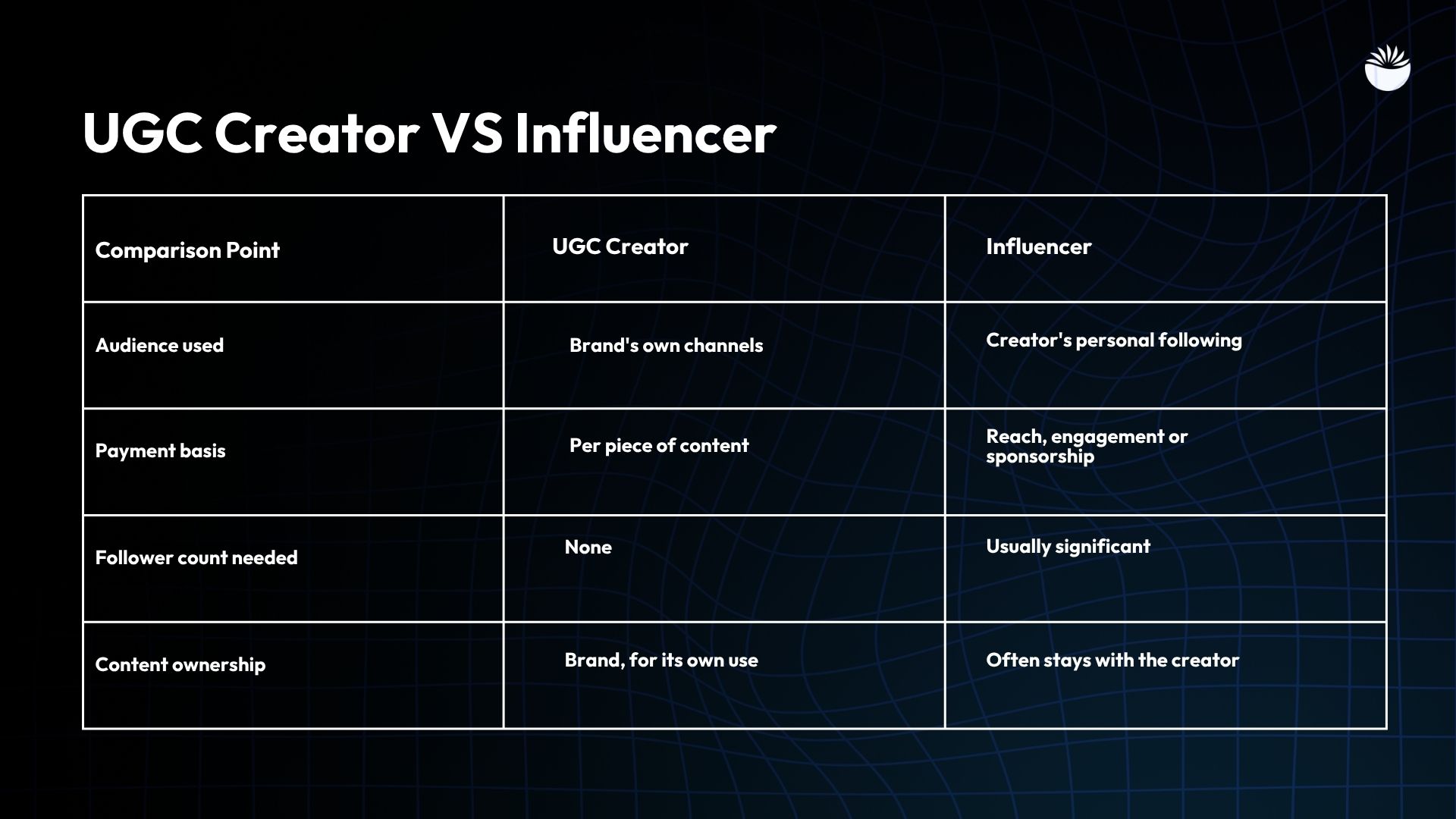
In short, a brand hires a UGC creator for the content itself and hires an influencer for the audience attached to it. Many performance-driven brands now use both, running UGC through paid ads while reserving influencer partnerships for reach and credibility.
Why UGC Converts: The Data Behind the Trend
The data behind this trend leaves little room for doubt. Consumer trust in peer-created content sits close to 90%. That comfortably outpaces trust in traditional advertising. Furthermore, UGC-enabled product pages generate up to 161% higher conversion rates than pages without it. Just ten genuine reviews can lift conversions by roughly 45%.
This pattern holds firmly within African markets too, not only in the Western studies most guides quote. Research published by the Nigerian Association of Social Psychologists found that visible user-generated content increases emotional loyalty on e-commerce platforms. It also increases repurchase intent among Nigerian shoppers specifically. Meanwhile, a Visa-commissioned study reported by BellaNaija found that 88% of Nigerian shoppers now use AI tools while shopping. Trust, however, still decides what happens at checkout. Authentic, peer-created content directly addresses that trust gap.
What This Means for Growth-Focused Brands
The data behind this trend leaves little room for doubt. Consumer trust in peer-created content sits close to 90%. That comfortably outpaces trust in traditional advertising. Furthermore, UGC-enabled product pages generate up to 161% higher conversion rates than pages without it. Just ten genuine reviews can lift conversions by roughly 45%.
This pattern holds firmly within African markets too, not only in the Western studies most guides quote. Research published by the Nigerian Association of Social Psychologists found that visible user-generated content increases emotional loyalty on e-commerce platforms. It also increases repurchase intent among Nigerian shoppers specifically. Meanwhile, a Visa-commissioned study reported by BellaNaija found that 88% of Nigerian shoppers now use AI tools while shopping. Trust, however, still decides what happens at checkout. Authentic, peer-created content directly addresses that trust gap.
What This Means for Growth-Focused Brands
For growth-focused brands, these figures translate into a simple commercial argument. Every naira spent sourcing and briefing genuine UGC tends to outperform an equivalent amount spent on polished production. This holds particularly true on product pages and prospecting ads. Social commerce in Nigeria alone is projected to nearly double in value by 2030, according to Mordor Intelligence’s market analysis. That growth only raises the stakes for brands still relying on branded-only content.
How to Build a UGC Strategy That Converts
Producing strong UGC is a repeatable process, not a matter of luck or a single viral moment. The fundamentals below apply whether a brand is just starting out or scaling an existing programme.
Sourcing Authentic Creators
Prioritise creators whose tone, audience and existing content already resemble the brand’s ideal customer. A creator does not need a huge following. In fact, smaller creators with genuinely engaged audiences frequently outperform larger ones on cost per result. Briefs should also leave room for the creator’s own voice rather than forcing a rigid script. Authenticity, after all, is exactly what makes this format work.
Briefing Without Killing Authenticity
A good UGC brief gives context, not a word-for-word script. Share the key product benefit and the tone to aim for. Flag any claims that must be avoided, then let the creator shape the delivery. Over-scripting is one of the fastest ways to strip out the very authenticity a brand is paying for.
Where to Use UGC
Product pages, checkout flows, paid social ads and email are the highest-leverage placements. Our full guide to building a UGC engine for performance marketers covers how to adapt this content for short-form video ads once the sourcing side is in place.
Common UGC Mistakes to Avoid
Even well-resourced teams stumble when they treat UGC as an afterthought. Over-scripting removes the authenticity that made the format effective to begin with. Skipping permission requests, meanwhile, creates avoidable legal risk. A simple release form solves that risk in minutes. Some brands also test only one or two pieces of content at a time. That makes it nearly impossible to isolate what is actually driving performance. Finally, treating UGC as a one-off campaign, rather than an ongoing pipeline, wastes the compounding value that consistent sourcing provides.
Finding the right creators, briefing them properly and testing at a volume that produces real data is close to a full-time job on its own. Welcome Tomorrow, one of the best growth marketing agencies in Africa, runs exactly this kind of UGC sourcing and testing pipeline for brands across the continent. Explore how our team can support your UGC strategy before results start slipping through the cracks.
Frequently Asked Questions About UGC
What does UGC stand for? UGC stands for user-generated content: any photo, video, review or post created by a real customer rather than by the brand itself.
Is UGC the same as influencer content? No. A UGC creator sells content for a brand’s own channels, while an influencer sells access to their personal audience. Some creators do both.
How much do UGC creators charge? Most UGC creators charge between $75 and $500 per video, depending on experience, niche and how quickly they can turn work around.
Do you need permission to use someone’s UGC? Yes. Always secure explicit written permission before repurposing a customer’s content in paid ads or on owned channels, even when the post is public.